
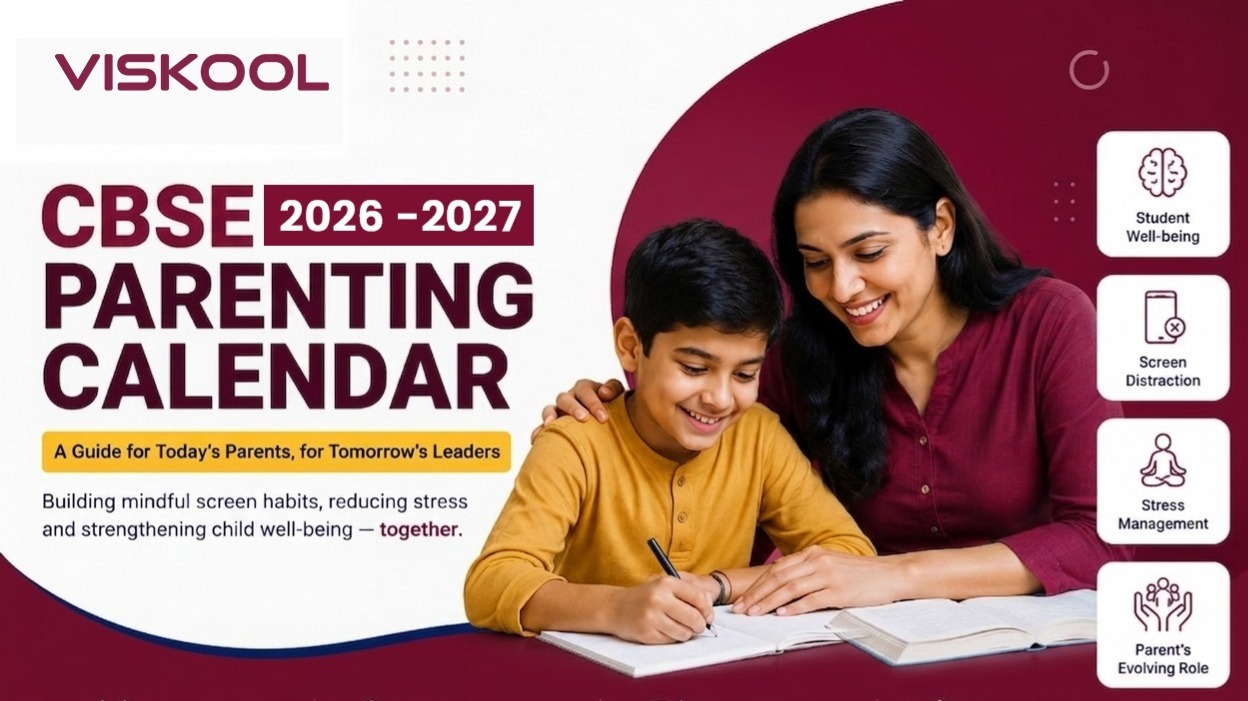
CBSE’s New Parenting Calendar 2026-27: Why Parents Matter More Than Ever!!
CBSE’s New Parenting Calendar 2026-27: Why Parents Matter More Than Ever
For years, most parents believed one thing:
“If my child scores well, everything is fine.”
But today, education is changing.
With the launch of the new CBSE Parenting Calendar 2026-27, the Central Board of Secondary Education is sending a very clear message:
Student success is no longer measured only by marks.
A child’s emotional well-being, stress levels, screen habits, discipline, focus, confidence, and mental health now matter just as much.
This is one of the biggest mindset shifts happening in Indian education today.
CBSE’s new framework encourages schools and parents to work together continuously — not just during PTA meetings or exam seasons. The goal is simple: build emotionally strong, confident, responsible students who can thrive both academically and personally.
According to CBSE, parenting today requires deeper involvement in a child’s emotional and digital life, especially in a world filled with distractions, social media pressure, anxiety, comparison culture, and academic stress.
What is the CBSE Parenting Calendar?
The CBSE Parenting Calendar 2026-27 is a structured framework introduced to strengthen collaboration between schools and parents.
Instead of focusing only on exam results and academic performance, the calendar promotes emotional well-being, mental health awareness, healthy screen habits, stress management, positive parenting, digital safety, better communication between parents and children, and holistic student development.
The initiative is aligned with the vision of NEP 2020, which emphasizes overall development instead of rote-learning and marks-driven education.
CBSE has also introduced age-specific guidance to help parents better understand the emotional and behavioral changes children go through at different stages of life.
Recent reports around the Parenting Calendar highlight concerns about increasing student stress, screen addiction, emotional withdrawal, and distraction among school students. Research and school observations also show rising concerns related to anxiety, reduced concentration, and unhealthy digital habits among children and teenagers.
Why CBSE Is Focusing on Parents Now
The reality is hard to ignore.
Many students today are struggling silently.
Some are dealing with exam pressure, constant comparison, lack of motivation, excessive screen time, sleep issues, anxiety, emotional isolation, social media distractions, and fear of failure.
And often, parents notice the marks before they notice the child.
That is exactly what CBSE wants to change.
The Parenting Calendar encourages parents to become emotionally aware, digitally responsible, and actively involved in their child’s daily learning environment.
CBSE has openly acknowledged that emotional support at home directly impacts student performance, behavior, focus, and confidence.
Marks Alone Cannot Define a Child
One of the strongest messages emerging from the CBSE Parenting Calendar is this:
A high-scoring student is not automatically a healthy or happy student.
A child may score good marks and still struggle with burnout, fear, loneliness, stress, emotional confusion, digital addiction, and low self-esteem.
Modern education is no longer only about memorizing chapters.
It is also about emotional intelligence, discipline, communication skills, self-awareness, consistency, confidence, problem-solving, and healthy routines.
Parents now play a major role in shaping these habits.
CBSE’s Strong Message on Screen Time and Digital Distraction
One major area highlighted in the Parenting Calendar is digital behavior.
CBSE has raised concerns about mobile addiction, excessive social media use, gaming dependency, reduced outdoor activities, lack of concentration, and emotional instability caused by digital overload.
Instead of simply banning devices, CBSE encourages parents to build open communication, monitor digital habits responsibly, create balanced routines, encourage offline activities, spend quality time with children, and teach healthy technology usage.
Recent nationwide observations among CBSE schools also showed that many students spend several hours daily on non-academic screen usage, affecting focus, classroom attention, and emotional balance.
The Real Responsibility of Parents in 2026
Today, parenting is not just about paying school fees, attending PTMs, asking for marks, or comparing ranks.
Real parenting now means understanding your child emotionally, building study discipline, reducing fear-based education, managing screen habits together, and supporting mental well-being.
Children learn better when they feel emotionally safe, motivated, and supported.
What Parents Should Start Doing Immediately
Parents should start spending more quality time with children without discussing marks all the time. Daily conversations help children feel heard and emotionally connected.
It is also important to watch for emotional signals like irritation, silence, lack of focus, sleep changes, or withdrawal, as these can often indicate stress.
Healthy routines matter too. Students need proper sleep, study discipline, physical activity, family interaction, and fewer distractions.
Most importantly, parents should stop comparing children constantly. Comparison damages confidence faster than failure.
Progress matters more than perfection.
How Schools and Parents Must Work Together
CBSE’s Parenting Calendar also changes the role of schools.
Schools are now expected to conduct parenting workshops, support mental well-being initiatives, improve communication with parents, promote emotional safety, and guide students beyond academics.
This creates a healthier ecosystem where parents, teachers, and students grow together.
Education becomes stronger when home and school move in the same direction.
What This Means for Students
For students, this shift is important.
It means you are more than your marks.
• Your mental health matters.
• Your emotions matter.
• Your habits matter.
• Your environment matters.
Success is no longer just about scoring high. It is about becoming capable, balanced, disciplined, and emotionally strong.
The Bigger Shift Happening in Indian Education
India’s education system is slowly moving away from pure rote learning, fear-based studying, and marks-only success culture.
It is moving toward holistic education, emotional intelligence, skill development, parent involvement, student well-being, and life readiness.
The CBSE Parenting Calendar is part of this larger transformation.
And honestly, this change was needed.
Because education should not create exhausted children.
It should create capable human beings.
How Viskool Supports Modern Learning
At Viskool, we believe education should help students grow with confidence, clarity, and consistency — not pressure and confusion.
Real learning happens when students receive proper academic guidance, personal attention, structured learning support, motivation, emotional encouragement, and a distraction-free learning environment.
That is why modern online learning platforms and guided tuition ecosystems are becoming increasingly important for students and parents today.
Because students do not just need more information.
They need better support.
Final Thoughts
CBSE’s Parenting Calendar 2026-27 is more than just another educational document.
It is a reminder.
A reminder that children are not machines built only for marks.
They are emotional, growing individuals trying to navigate pressure, distractions, expectations, and uncertainty.
And in this journey, parents matter more than ever.
Not as controllers.
But as guides.
The future of education will not belong only to the smartest students.
It will belong to students who are emotionally balanced, disciplined, focused, adaptable, and supported both at school and at home.
At Viskool, we are committed to supporting students with guided learning, personal attention, and a healthier learning environment that helps them grow with confidence — both inside and outside the classroom.
Because every child deserves support, not just pressure.
Frequently Asked Questions (FAQ)
What is the CBSE Parenting Calendar 2026-27?
The CBSE Parenting Calendar 2026-27 is a structured framework designed to improve parent-school collaboration and support students’ emotional, social, and academic development.
Why did CBSE introduce the Parenting Calendar?
CBSE introduced the Parenting Calendar to encourage holistic education, emotional well-being, healthy digital habits, and stronger parental involvement in student development.
Does CBSE now consider parents responsible for student performance?
CBSE emphasizes that parents play a major role in shaping a child’s emotional environment, discipline, screen habits, and mental well-being, all of which impact academic performance.
What are the major concerns highlighted by CBSE?
The Parenting Calendar discusses stress, anxiety, screen addiction, emotional well-being, cyber safety, peer pressure, and healthy parenting practices.
How can parents help children study better?
Parents can help by creating routines, reducing distractions, encouraging emotional communication, avoiding comparison, and supporting consistent learning habits.